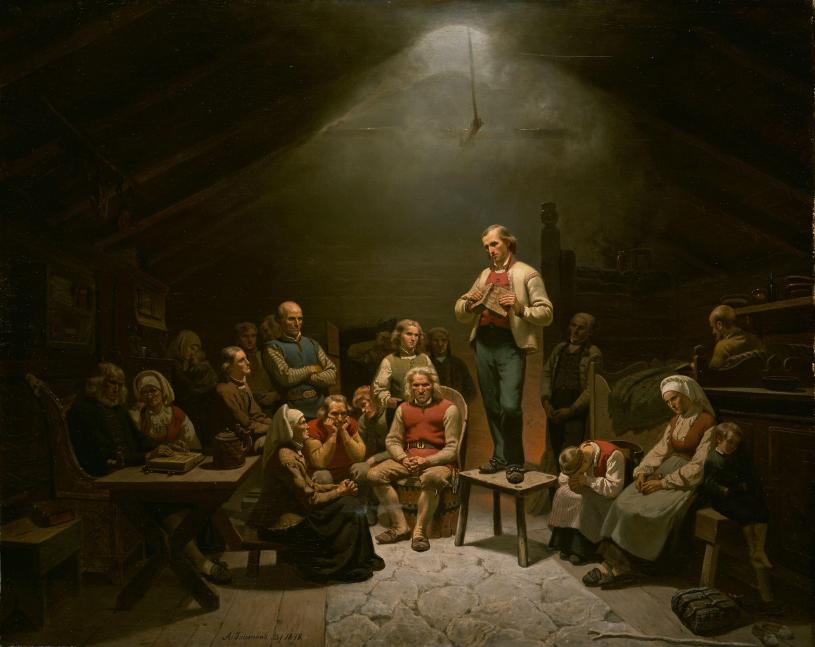
Haugianerne av Adolph Tidemand (1848).
Torsdag 4. november arrangeres digitalt foredrag i regi av NAHA-Norge, i samarbeid med NAHA i USA. Arrangementet organiseres som et webinar, og begynner klokken 19.00 norsk tid.
Arrangementet dreier seg om Hans Nielsen Hauge, og temaet er valgt i sammenheng med 250-årsjubileet for hans fødsel her i Norge. Men Hauge er også kjent i USA, og mange haugianere deltok i den første organiserte utvandringen til Amerika fra 1825 til 1850-årene.
Foredraget holdes av Vidar Haanes. Haanes er professor i kirke- og lærdomshistorie og rektor ved MF vitenskapelig høyskole for teologi, religion og samfunn. Et sammendrag av foredraget følger nederst i denne artikkelen.
NAHA i USA har det tekniske ansvaret, og arrangementet vil foregå på engelsk. Du kan registrere din deltakelse ved å klikke på den følgende lenken, og registrere navn og epostadresse. Du vil da få tilsendt en lenke som du trykker på for å koble deg opp til møtet ved møtestart.
Bruk følgende lenke for registrering: https://stolaf.zoom.us/webinar/register/WN_LIrBTWuVSz-tcMaGls9YYA
Sammendrag av foredraget:
Tittel: Millennial Hopes and Scandinavian Immigrants to America: Norwegian Haugeans in Context.
The immigration from Scandinavia to America started in the seventeenth century. A large number of dissident groups followed, leaving their homelands for religious, political or economic reasons. Utopian and millenarian ideas were exported to America and flourished, partly in a sectarian, religious form, partly in a secularized, communitarian form. Scandinavians arriving with later waves of immigration were often motivated by the ideals of “the Land of Promise”, and some by “the Promised Land”.
Within this framework, we will discuss the push and pull factors for Haugeans to join the first, organized emigration from Norway to America in 1825. Haugeans represented early revival Christianity with the personal, religious choice, and responsibility for their own lives and future both here and beyond. The social relations were lifted out of the traditional, steadfast class society, and were reorganized and linked to the society of friends.
The Haugeans’ training in social mobility is an important prerequisite for emigration. We look into the development of Haugeanism in the Norwegian settlements, from the first, vital role of the Haugean preachers to the gradual institutionalization in the late 1840s. Both synods and colleges bore Hans Nielsen Hauge’s name in America.
Many Norwegians, also Haugean preachers, joined the religious community who succeeded in establishing their Zion on the American continent, the Latter Days Saints. We will trace some of the connections and networks that constitute a Jerusalem code amid Scandinavian immigrants to America.
Vidar L. Haanes is Professor of Church- and Intellectual History and Rector at MF Norwegian School of Theology, Religion and Society in Oslo. He has been the President of Universities Norway and member of the Council of European University Association. He has written books and articles on theological education, the Protestant Reformation and Norwegian-American history, and is a lifetime member of NAHA.
 NAHA-NORGE